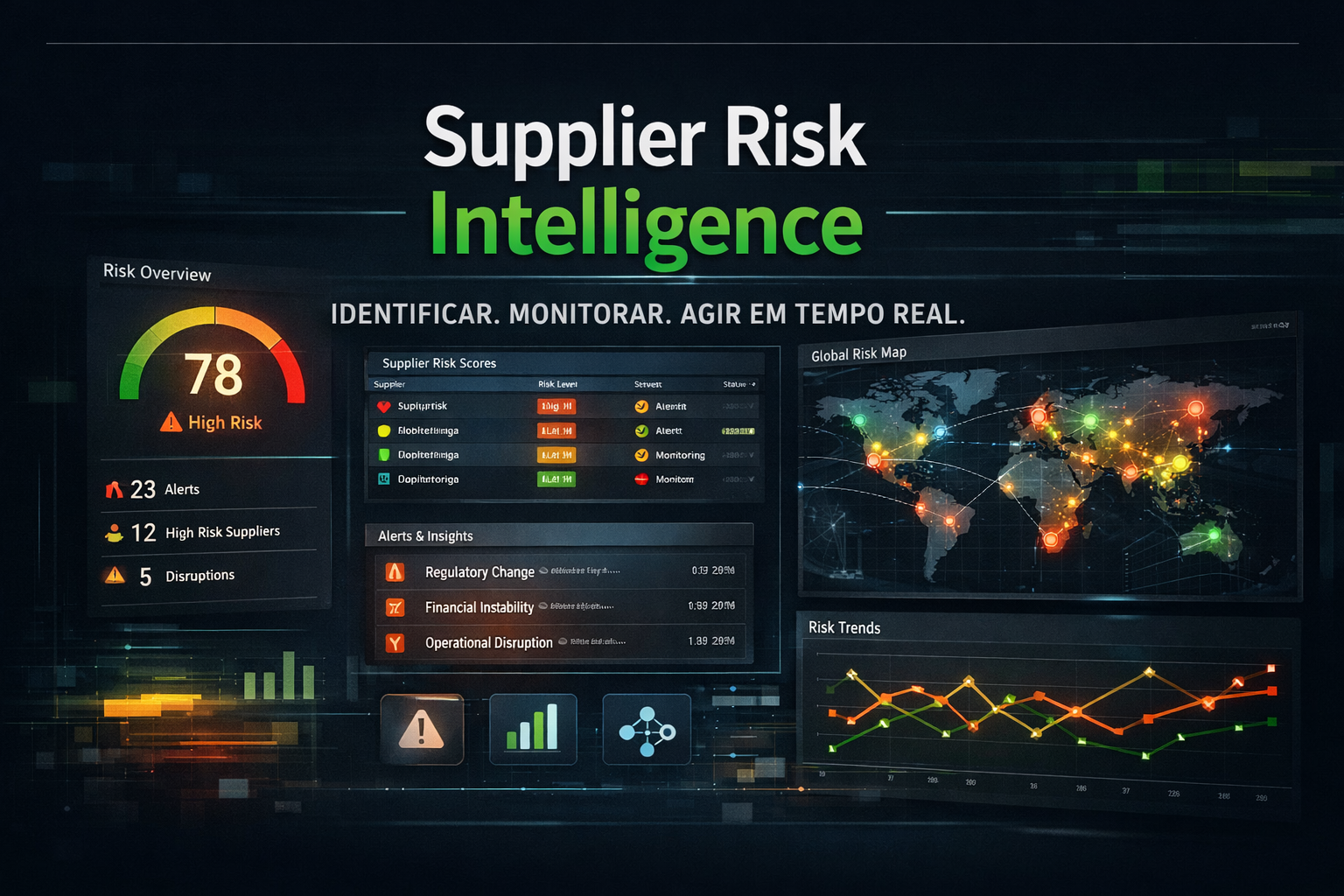
Supplier Risk Intelligence: how to identify, monitor, and act on supplier risk in real time
Suppliers are a critical part of any operation — and also one of the biggest sources of invisible risk in global supply chains.
Companies invest time and resources to discover and initially approve suppliers, but often assume that status remains valid over time. In reality, suppliers change: operational structure, production capacity, quality, compliance, regulatory context — and even commercial intent.
It is precisely in this silent gap — between initial approval and the real problem — that delays, rework, financial losses, and reputational risk emerge.
Supplier Risk Intelligence exists to close that gap.
What is Supplier Risk Intelligence?
Supplier Risk Intelligence is the practice of assessing, monitoring, and anticipating supplier-related risks using public data, web intelligence, operational signals, and AI-powered automated analysis.
Unlike one-time audits or static checklists, Supplier Risk Intelligence runs continuously and covers the full supplier relationship lifecycle.
It answers critical questions such as:
- ✓ Is this supplier still reliable?
- ✓ Has risk increased since the last order?
- ✓ Are there signals of operational or regulatory change?
- ✓ Should I proceed, monitor, or avoid this supplier?
Why initial approval is not enough
Most supplier issues do not happen on the first order.
The first order is usually the supplier’s best behavior:
- fast communication
- on-time delivery
- commercial focus
Later is when you see:
- recurring delays
- quality decline
- silent organizational changes
- lost or expired certifications
- “ghost” suppliers
Approved supplier ≠ safe supplier.
Without continuous monitoring, teams discover issues only after impact happens — and often when there is no viable alternative.
Main types of supplier risk
1. Authenticity risk
- Shell companies
- Newly created domains
- Inconsistent information
- Duplicate identities
2. Operational risk
- Portfolio changes
- Unstable production capacity
- Irregular communication
- Reduced digital activity
3. Regulatory & compliance risk
- Expired certifications
- Legal changes in the country of origin
- Trade sanctions
- Export/import restrictions
4. Country risk
- Political instability
- Currency risk
- Trade barriers
- Logistics exposure
How continuous supplier monitoring works
A modern Supplier Risk Intelligence system combines:
Continuous web tracking
Monitors changes across websites, registries, and digital presence
AI-driven analysis
Classifies signals and detects anomalies
Real-time alerts
Notifies critical changes as soon as they happen
Change history
Tracks supplier evolution over time
The goal is not just to display data — but to know when to act.
How SourcelyHub applies Supplier Risk Intelligence
SourcelyHub automates the full supplier intelligence cycle:
- Global discovery of suppliers with AI
- Multi-layer verification
- Trust Score™ (0–100) based on 10+ signals
- Automated continuous monitoring
- Critical change alerts in real time
- Clear engagement recommendation:
- ✅ Proceed
- ⚠️ Monitor
- 🚫 Avoid
Explore SourcelyHub features
Who benefits from Supplier Risk Intelligence?
Procurement & Strategic Sourcing
Supply Chain
Compliance & Audit
Import & Export
Global Purchasing
Business Intelligence
Conclusion
Supplier Risk Intelligence is not about distrusting suppliers.
It’s about not being caught by surprise.
Companies that monitor suppliers continuously make safer decisions, reduce losses, and build resilient supply chains.